Welcome!
Hae Jin (Hayley) Song
Fellow at Berkman Klein Center at Harvard University
AI Research Fellow at ThoughtWorks Inc.
Ph.D. in Computer Science


Recent updates!
- 2026 Jan: Working on updating my blog...:-)
- 2025 Nov: Attending Workshop on Geometry, Topology, and Machine Learning (GTML 2025) at Max Planck Institute for Mathematics in the Sciences. Excited to meet new friends working at the intersection of geometry and machine learning!
- 2025 Oct: Very grateful and excited for this opportunity to join Berkman Klein Center at Harvard University as AI fellow, working on principled methods of scalable and robust AI design, development and governance.
- 2025 June: Excited to share that our paper on "Riemannian-geometric fingerprints of generative models" is accepted to ICCV 2025 as a highlight paper! Please check it out here: https://arxiv.org/abs/2506.22802
- 2024 Feb: Our paper (ManiFPT: On Defining and Analyzing the Fingerprints of Generative Models) is accepted to CVPR 2024!
- 2024 May: I am invited to an AI meeting hosted by LG AI Research in the Bay Area to give a spotlight talk on my research. Thank you!
- 2023 Dec: Our paper on model attribution is accepted to NeurIPS Workshop on Attribution at Large Scale.
- New post: "Total variation, KL-Divergence, Maximum Likelihood"
- New post: "Let's be honest: peeling the assumptions that get us to Variational Autoencoders"
- New post: "Thinking about an observer vs. the observed"
- I am preparing for a talk at SciPy 2021 in July.
- I got accepted to 2021 Complex Systems Summer School at Santa Fe Institute, Woohoo!
- I gave my first tutorial @ PyData LA, 2019 on "Experimental ML with Holoviews/Geoviews + Pytorch". Here are my talk slides, video and jupyter notebook materials!
- I participated in Geo4Good @ Google in Mtn View, CA! Check out some highlights of inspiring projects based on Google Earth Engine and Studio.
I am currently a Fellow at the Berkman Klein Center at Harvard University and an AI Research Fellow at ThoughtWorks, where I work on geometric foundations of scalable and robust AI interpretability and safety.
My research develops formal, geometry-based frameworks for understanding, analyzing, and steering the behavior of modern generative models. I hold a Ph.D. in Computer Science from the University of Southern California. I earned my B.S. and M.Eng. in Electrical Engineering and Computer Science from MIT, with a minor in Mathematics. During my M.Eng., I specialized in artificial intelligence and worked under the joint guidance of Prof. Regina Barzilay and Dr. Julian Straub on computer vision problems in medical imaging, including non-rigid mammogram registration for breast cancer detection and 3D reconstruction of human arms for lymphedema screening.
Across my academic career, I have conducted research at MIT (CSAIL, Media Lab, McGovern Institute), INRIA (ILDA Lab), and USC (Information Sciences Institute, Visual Intelligence and Multimedia Analytics Laboratory (VIMAL), iLab, Knowledge Computing Lab).
I have also had industry research internships at Apple, MathWorks, and a French robotics startup, Keecker.
Research Interests
Geometric Foundation of Generative Models
& Applications for Scalable and Robust AI Design, Development and Governance
My current research focuses on how complex, high-dimensional information-processing systems, particularly modern generative models and other AI models, behave, using tools from differential geometry, Riemannian manifolds, latent-space topology and Bayesian methods.
My goal is to develop principled and scalable methods to characterize, attribute, and control model behaviors by identifying geometric “fingerprints” of their internal representations and dynamics. My work addresses foundational questions in the analysis and controllability of generative models, with applications to AI interpretability, model attribution, deepfake detection, bias and degeneration analysis, and model steering for safety and alignment.
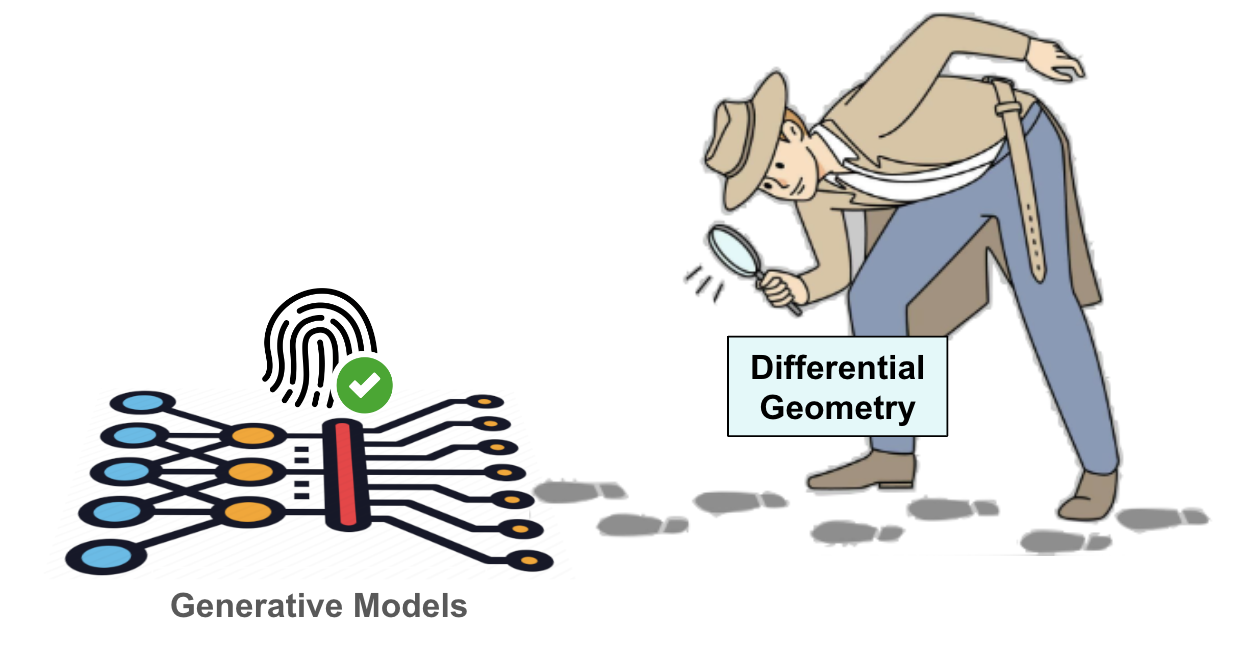
My recent work has made significant contributions to these questions through research on fingerprinting generative models: In papers published at CVPR 2024 and ICCV 2025 (Highlight), we introduced a novel theoretical framework that represents model behavior on data manifolds and formalized the notions of “artifacts” and “fingerprints” of generative models in a geometric language. This framework enables effective attribution and systematic comparison of state-of-the-art generative models.
More broadly, through this line of research, I aim to advance a generalized theory of generative models and their internal mechanisms, to help shape the safe and responsible integration of Generative AI into our society in ways that serve humanity.
Geometric Fingerprints of Generative Models
Broadly, my research interest lies in understanding how complex, high-dimensional information-processing systems (e.g., human intelligence, modern generative models, collective behaviors like traffic patterns) behave and developing efficient algorithms to analyze their characteristics and traces in a principled way, from geometric perspectives. Through this geometric understanding of their properties and internal mechanisms, I aim to improve their behaviors (e.g., steering away from degenerative patterns and biases while aligning to more proper values), by mechanistically intervening in their internal causal pathways. Of many such complex systems, my PhD research focuses on generative models and representation learning algorithms.
Currently, despite the rapid development of Generative A.I., there is still a big gap in our understanding and control over their designs and behaviors. My aim is to fill this gap, by developing a formal framework and efficient algorithms that can represent, analyze and control the behaviors of generative models (e.g., Large Foundation Models (FMs)) in their high-dimensional spaces.
To this end, I approach these problems from geometric perspectives, and I am working on formalizing the theory of (generative) model behaviors using Differential Geometry and Riemannian Manifold. Grounded on this theory, I also work to develop efficient algorithms that can extract geometric signatures of the behaviors and internal representations of large generative models (which live on much higher dimensional spaces than what the current geometric approach has been employed (e.g., 1D signals or 3D images) ), in order to "fingerprint" and characterize them.
My recent work and extensions
I have started on this research endeavor through my work on fingerprinting generative models: In our recent work published in CVPR 24, we proposed a useful theoretical framework to represent model behaviors on a data manifold (i.e., as vector fields on a data manifold constructed from real images). We also formalized, for the first time in the literature, the definition of “artifacts” and “fingerprints” of generative models in a geometric language, and proposed an effective attribution method to study and compare vision generative models. (See more details here.)
-
I am excited to extend this work to a larger variety of Foundation Models, including LLMs and SoTA multimodal models, to study their fingerprints and proactively watermark the models.
-
I will also look into their internal mechanisms that cause these fingerprints and develop principled methods to intervene and control causal pathways that are responsible for different model behaviors (e.g., image artifacts by Vision GMs or hallucinations in LLMs).
I hope by researching these problems, I will contribute to a generalized theory of generative models and their internal mechanisms, which in turn help shape a safe and responsible integration of Generative A.I. into our society.
Please see more details on my research in my publications and projects :)
Archived Details
Click to expand
My journey started from noticing our own ability to (i) break down a complex observation into multiple chunks of smaller and abstract concepts and (ii) create a new idea by playing and recombining the conceptual building blocks. For instance, we can take a glimpse of this dance between abstraction and synthesis in a video of Picasso's live drawing:More about next steps...
- Understanding adversary at the latent space from the perspectives of information flow and non-equilibrium achieved by the adversary, ie. the Maxwell's Demon at the gate that distinguishes the two latent partitions
- GAN models are often described in the framework of min-max games between a generator and an adversary. In particular, there has been works making a connection between Nash Equilibrium and local minimum of the GAN's objective function. This connection motivates me to view my adversary (at the latent partitions) as an 'information sorter', like the Maxwell's Demon. The goal of this information sorter is to organize the semantic information into one latent partition, and the domain-specific information into the other latent partition, so that each partition (equivalent to a gas chamber in Maxwell's thought experiment) contains only its type of information. This approach will allow me to bring in computational tools from information theory and theromodynamics (flow of information) to understand how the adversarial information sorter actually achieves the partitioned latent space.
- Evaluation of the disentangled partition requires a measure of semantic information
- In order to evaluate how well our semantic latent space captures the semantic information in the inputs, we first need a well grounded _definition of the semantic information_, as well as _computational methods to efficiently compute_ the value.
- See An Outline of a Theory of Semantic Information, a nice survey, and more recent work by Kolchinsky and Wolpert.
- Linking the discovered latent factors to external knowledge graph